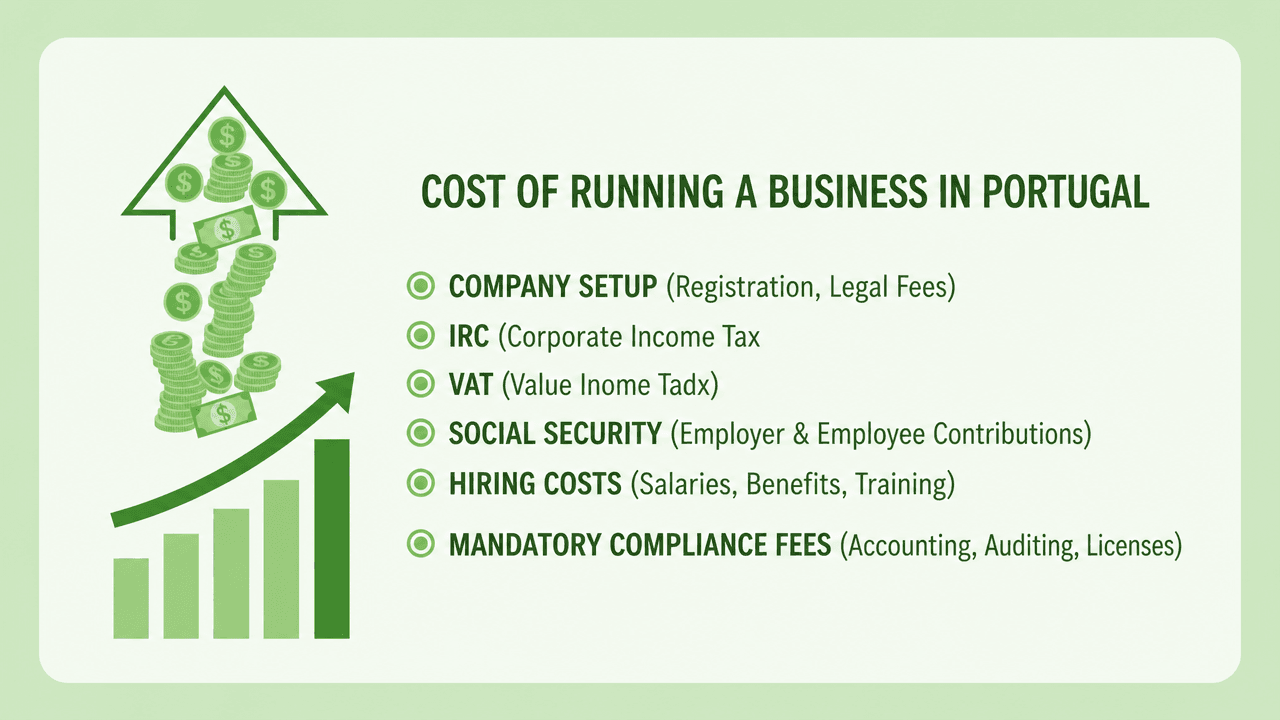
Portugal has become one of Europe's most attractive places to start a company with EU market access, a competitive tax system, and a genuinely pleasant place to live. But the cost of running a business in Portugal is rarely just the headline tax rate, and before you commit it helps to know exactly what you're signing up for. A few mandatory costs catch newcomers by surprise.
Here's an honest, friendly breakdown of the cost of running a business in mainland Portugal in 2026, from starting a company through to the mandatory business costs that follow. (Madeira and the Azores have their own, generally lower, rates, worth exploring separately.)
1. The Cost of Getting Started
So how much does a company cost to open in Portugal? Refreshingly little: the process is quick and inexpensive by European standards. The most popular structure, the Lda (private limited company), requires a minimum share capital of just €1 per shareholder.
The main setup costs are:
- Empresa na Hora (in person): around €360 for same-day incorporation.
- Empresa Online: around €220 if you use pre-approved articles of association.
- **Custom company name certificate **(optional): about €75, or €150 if you need it urgently.
Getting your company tax number (NIF) at the tax office is free, and registering with Social Security is free too. So realistically, you can be fully incorporated for a few hundred euros — though most founders also budget for a service provider or lawyer to handle the paperwork, which adds a fee on top.
One thing to plan for in 2026: registry backlogs. Staffing shortages and strikes at the IRN have slowed name approvals and registrations, so allow extra time.
2. Taxes: What You'll Owe
Corporate Income Tax (IRC)
Portugal has been steadily lowering its corporate tax rate. For 2026, the standard IRC rate on the mainland is 19% (down from 20% in 2025), and it's scheduled to keep falling to 18% in 2027 and 17% in 2028.
There's good news for smaller companies: qualifying SMEs pay a reduced 15% rate on the first €50,000 of taxable profit, with the standard 19% applying above that. To qualify as an SME here, you generally need fewer than 250 employees and turnover under €50 million.
Watch out for surcharges on top of IRC:
- Municipal surcharge (derrama municipal): up to 1.5% of taxable profit, depending on your municipality.
- State surcharge (derrama estadual): kicks in only on profits above €1.5 million (3%, 5%, or 9% across higher bands).
VAT (IVA)
If you sell goods or services, you'll deal with VAT. Mainland rates are 23% (standard), 13% (intermediate), and 6% (reduced). VAT returns are filed monthly or quarterly depending on your turnover, and everything runs through the e-Fatura invoicing system.
Personal Income Tax (IRS) and Withholding
If you draw a salary or pay yourself as a director, that income is subject to IRS (personal income tax), which is progressive. Companies also act as withholding agents, deducting IRS at source from salaries and certain payments to suppliers and remitting it to the tax authority.
Social Security: The Company's Contribution
Portugal's Social Security contribution, the Taxa Social Única (TSU) is split between the company and the individual. For a company director who is a managing member (gerente or administrador), the combined rate is 34.75%, broken down as:
- 23.75% paid by the company, and
- 11% paid by the director (deducted from their remuneration).
These are applied to the director's actual remuneration, and contributions are uncapped — there's no ceiling above which they stop.
The Minimum Contribution When There Are No Employees
Do you still pay Social Security with no employees? For most companies, yes and it's a point that surprises many first-time founders: even a company with no employees usually still owes Social Security. A private limited company (Lda) has a managing director, and once that person is registered as a statutory board member, contributions are due, regardless of whether they draw a salary.
The rules work like this:
- If the director takes a salary, the 23.75% (company) and 11% (director) rates apply to that amount.
- If the director takes no salary, contributions don't disappear. Instead, they're calculated on a minimum base of one IAS (the Social Support Index), which is €537.13 in 2026.
In practice, that minimum means an unpaid managing director still generates roughly:
~€127.57/month from the company (23.75% × €537.13), and ~€59.08/month from the director (11% × €537.13),
for a combined minimum of about €186.65 per month, even with zero payroll and zero salary. If the company formally resolves not to pay the director, it must notify Social Security (with a copy of the relevant minutes).
One exception worth knowing: if the director is already contributing through another mandatory scheme. For example, as an employee elsewhere, they may be exempt from contributing again on the same basis. And if you instead operate as a self-employed person rather than through a company, the rate is 21.4% on 70% of your service income, with the first 12 months of activity generally exempt.
3. Employment Costs: The Full Picture
The true cost of hiring an employee in Portugal is where the gap between the salary on the contract and what you actually pay is widest and where budgets often go wrong.
Start with the basics for 2026:
- Minimum wage: €920/month gross.
- 14 payments a year, not 12. Portuguese employees receive their monthly salary plus a holiday subsidy and a Christmas subsidy, each equal to a month's pay. So minimum wage is €920 × 14 = €12,880/year.
On top of gross pay, employers must budget for:
- Employer Social Security (TSU): 23.75% of gross salary — charged on all 14 payments.
- Workplace accident insurance: mandatory from day one, roughly 1–1.75% of payroll.
- Meal allowance: standard practice, and tax-efficient when paid by meal card within the exempt daily limit (around €10.20/day).
- Mandatory training: 40 hours of certified training per employee per year, or it accrues as a liability you may have to pay out.
Add it up and total employer cost typically runs 25–45% above gross salary, depending on how you count. For a minimum-wage worker, the all-in annual cost lands somewhere around €16,000.
It's also worth knowing that Portugal doesn't recognise at-will employment. Dismissals require proper cause or a redundancy process, which is an important consideration before you hire.
4. Other Mandatory and Compliance Costs
A few essential items that are easy to overlook:
Certified Accountant (Contabilista Certificado). Is a certified accountant mandatory in Portugal? For any company with organised accounting, yes — it's a legal requirement from day one, and only a CC registered with the OCC can sign off your accounts and tax filings. Fees vary with the size and complexity of the business and the volume of invoices, but as a guide, small companies in Portugal typically pay somewhere between €75 and €500 per month, with the average around €250/month.
Certified invoicing software. If you issue invoices, Portugal requires software certified by the tax authority (AT) once your annual turnover exceeds €50,000 (below that, you can invoice for free directly through the Portal das Finanças). Certified cloud tools are inexpensive. Popular options run from roughly €6 to €25 per month depending on features like POS or stock management. A detail for 2026: PDF invoices sent by email are only legally valid with a qualified electronic signature.
Ongoing filing costs. Most routine filings including the periodic VAT returns, withholding tax, and the annual IRC return (Modelo 22), carry no government fee of their own; the real cost is your accountant's time, already covered above. The main standalone charge is the annual IES (Informação Empresarial Simplificada). The IES cost in Portugal is often misunderstood: submitting the declaration itself is free, but it triggers a mandatory accounts-deposit fee of €80 at the commercial registry, due within a few days of submission. Missing the deadline brings fines that can run into the hundreds or thousands of euros, so it's worth diarising.
Other compliance items:
- RCBE (beneficial ownership declaration): required after incorporation and kept up to date.
- SAF-T accounting files: used by the tax authority to pre-fill filings; note the full accounting SAF-T obligation has been deferred to the 2027 financial year (filed in 2028).
- Occupational health & safety: if you have employees, you'll need a certified provider for workplace health and safety, including medical exams.
The Bottom Line
Getting a Portuguese company off the ground is cheap and fast, often a few hundred euros. The real, ongoing costs are the ones that follow: a competitive but layered tax system, meaningful employer contributions if you hire, and a handful of mandatory compliance obligations (a certified accountant chief among them).
None of it is prohibitive, and for many businesses the trade-off is well worth it. The key is going in with clear eyes and a realistic budget and getting the right advice for your specific situation, since regional regimes and tax incentives can change the maths considerably.